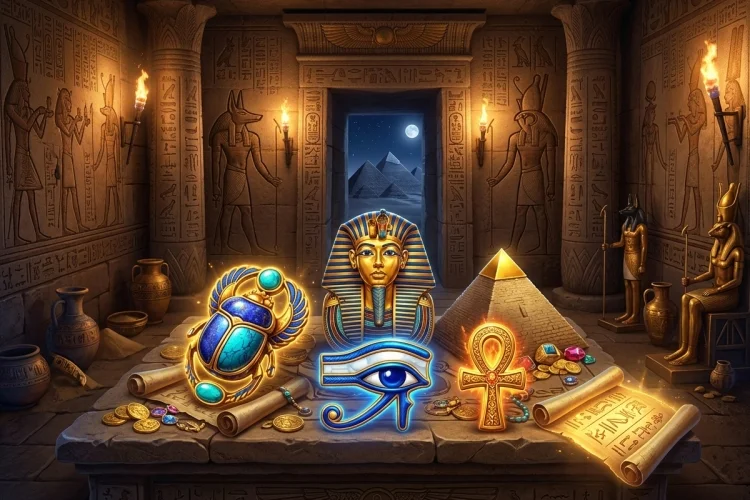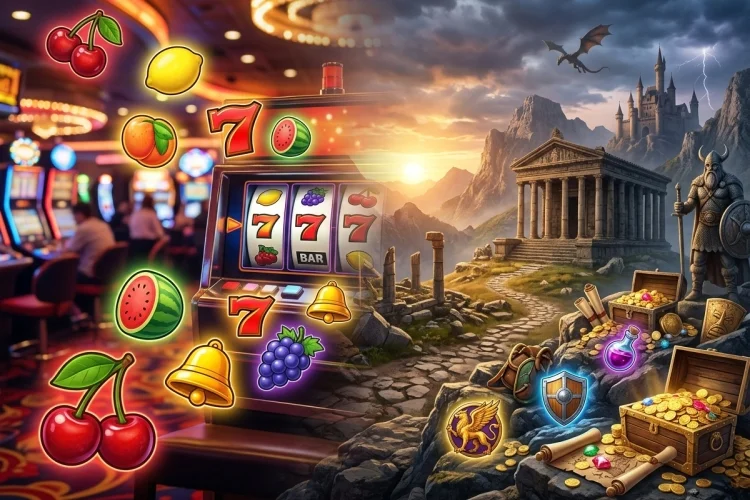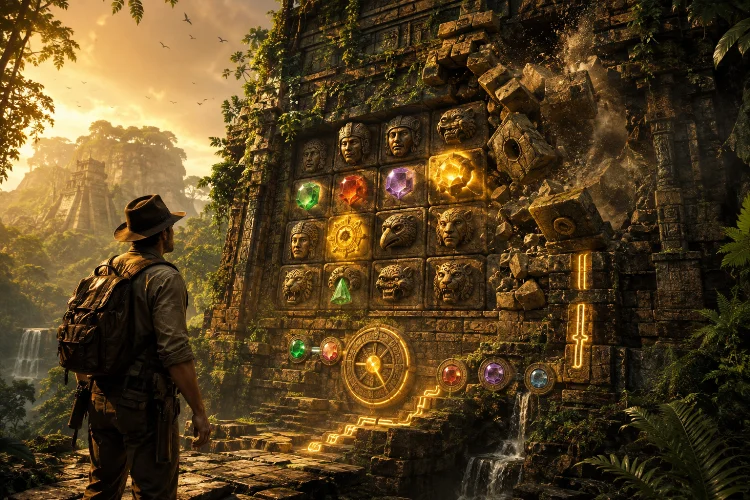
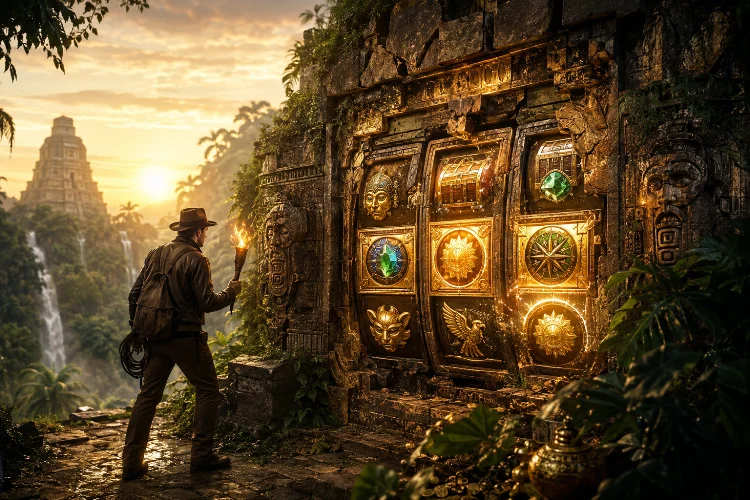
A slot feature can be mechanically clever and still feel strangely disconnected. A wild appears, a multiplier rises, or a bonus round starts—but without context, these events may feel like separate mathematical functions rather than parts of one coherent experience.
This is where Slot Features and Narrative Design begin to overlap.
Modern game designers increasingly use characters, locations, progression, sound, and visual storytelling to explain why a feature happens and what it represents. A growing reel can become a collapsing temple. A transforming wild can represent a character using a special power. Free spins can become another chapter of an adventure.
Research outside slot gaming also suggests that storytelling can increase interest and perceived engagement in digital games, although the effect depends on the task and design.
Good narrative therefore does more than decorate mechanics. It can change how players understand and interact with them.
Narrative Gives Mechanical Events a Reason
Imagine two games using exactly the same expanding-wild feature.
In the first game, a wild lands and simply grows across the reel.
In the second, a lightning god appears, strikes the reel, and transforms the original symbol into a full wild column.
Mathematically, the outcome might be identical.
Experientially, it is not.
The second design gives the transformation a cause. The player can connect the visual event with a character and remember what that character does.
This approach can make complicated features easier to learn because mechanics become attached to recognisable actions.
Play’n GO’s 13th Trial Hercules Abyssways illustrates this relationship. Its reel structure grows and contracts during Free Spins while Hera destroys symbols from below, Zeus affects wilds, and Pegasus can restore Hercules symbols. The provider explicitly presents the changing grid as part of the mythological conflict rather than as an unrelated mathematical effect.
The story becomes an explanation layer for the mechanic.
Characters Can Function Like Visual Instructions
Characters are especially useful when several mechanics exist in one game.
Suppose three heroes have different abilities.
One creates wilds.
Another triggers respins.
The third activates a multiplier.
Instead of expecting someone to remember three abstract rule names, the interface can associate each feature with a distinctive character.
Play’n GO uses a similar structure in Trinity Impact. The game follows three characters on a fantasy adventure, while transforming wilds, respins, and an Ultimate Attack feature are integrated into the elemental theme and character roles.
This creates a simple learning shortcut:
character appears → familiar mechanical behaviour follows
Over time, players may recognise the feature before reading any text.
That can make the game feel more intutive, particularly on mobile screens where lengthy explanations compete with limited space.
Narrative Design therefore supports usability as well as atmosphere.
Bonus Rounds Can Feel Like Story Progression
Free spins traditionally function as a separate mathematical state.
The reels may change, multipliers may increase, or additional symbols may become available.
Narrative design can turn that transition into something more meaningful.
Instead of merely displaying “10 Free Spins,” the game might move from a village into a castle, descend underground, enter a battle, or reach another stage of a character’s journey.
The important mechanic is still the bonus.
But the environment communicates that the game state has changed.
Research on interactive narrative games has examined the relationship between narrative structure, player interaction, and progression mechanics, highlighting how progression can become part of the way players interpret their role within an interactive experience.
Slots obviously offer far less agency than narrative adventure games, so the comparison should not be pushed too far.
Still, the design principle translates well: progress feels clearer when the game communicates where the player is within a larger sequence.
Progress Meters Become More Meaningful With Context
Many slots use meters.
Collect five objects.
Fill four positions.
Reach another level.
Increase a multiplier.
Mathematically, these systems track a variable. Narratively, they can represent a journey.
Play’n GO’s Crabby’s Gold, for example, uses a persistent Rum Barrel Meter where collected bottles unlock increasingly advanced wild types.
Instead of showing an abstract number increasing, the feature gives progression a thematic object.
That matters because a meter can answer two questions simultaneously:
What is happening mechanically?
and
Why am I collecting this?
This connection can make feature progression easier to follow.
It also makes later states feel related to earlier ones rather than appearing randomly.
The narative thread provides continuity between spins.
Environment Changes Can Signal Feature States
Storytelling does not always need dialogue or text.
Sometimes the background does the work.
A calm forest might become stormy as a multiplier increases. A temple could begin collapsing as cascades continue. A spaceship could travel closer to its destination whenever a meter advances.
These changes provide visual feedback about the current game state.
Play’n GO’s Rosy Orbit Treasure Turn offers a particularly literal example. After wins, its 5×5 grid rotates 90 degrees and symbols shift before cascading again. The provider connects this unusual mechanical movement with the game’s tiny-planet setting and space-based narrative.
The mechanic therefore feels like an action happening inside the world, rather than an interface rule being applied outside it.
This can improve feature readability because players see movement and story feedback at the same time.
The enviroment becomes part of the UI.
Story Can Influence How Players Anticipate Features
Narrative design can also shape anticipation.
Imagine a dragon slowly waking as a bonus meter fills.
The actual bonus probability may be controlled entirely by the mathematical model, but the animation provides a visual representation of progress when the rules genuinely support such progression.
Likewise, a villain appearing before a special round can signal that a different feature state is beginning.
This creates anticipation through context rather than simply flashing “BONUS.”
Play’n GO has said that modern mechanics can be designed around a sense of progression and that themes, storylines, graphics, music, and mechanics are developed together as parts of the broader experience.
The key design challenge is making sure the narrative does not imply probabilities that are not actually present.
A character looking “almost ready” to trigger something should not falsely suggest that a random bonus is becoming statistically due.
Story should explain the feature, not distort the math.
Narrative Must Never Replace Clear Rules
Immersion is useful, but clarity remains more important.
A beautifully animated wizard casting spells does not remove the need to explain what those spells actually do.
In Great Britain, for example, the Gambling Commission requires game information to explain how games work, how winners are determined, how prizes are allocated, and relevant information about the likelihood of winning.
Narrative is therefore an additional communication layer rather than a substitute for rules.
A player should be able to enjoy the visual story while still accessing a clear explanation such as:
“The Wizard Wild expands to cover the entire reel.”
That sentence removes ambiguity.
Good designers let animation make the feature memorable and documentation make it precise.
This is especially important when several similar-looking effects have seperate mathematical functions.
Strong Narrative and Mechanics Should Point in the Same Direction
The strongest designs tend to avoid situations where the story says one thing while the feature does another.
If a game is about exploration, progression mechanics may involve discovering locations or collecting objects.
If it is about combat, wilds and multipliers can represent attacks, weapons, or character abilities.
If it is built around transformation, expanding grids and evolving symbols naturally fit the theme.
This is sometimes called theme-mechanic alignment.
The benefit is not that the slot suddenly becomes a role-playing game.
Instead, the mechanical behaviour becomes easier to interpret because the visual language supports it.
Every feature has a reason to exist inside the fictional world.
When that alignment works, players spend less time asking, “What was that feature?” and more time recognising its role immediately.
That is the difference between decoration and real Narrative Design.
Slot Features become easier to understand when Narrative Design gives them characters, goals, environments, and visual consequences. Story can turn multipliers into power growth, bonuses into new chapters, and wild transformations into meaningful events.
Designers should connect narrative and mechanics carefully, while keeping probabilities and rules transparent. When both layers support each other, interaction feels more coherent rather than simply more decorative.